 InRoom Wall Art
Home › Guides › Increasing conversion
How to increase conversion in an art store
Most art stores don't have a traffic problem. They have a hesitation problem: the visitor likes the piece, can't picture it on their wall, and leaves to think about it. They don't come back.
It isn't the price
When a piece doesn't sell, the first instinct is to discount it. That is almost always the wrong lever, and it's an expensive one: a 15 % discount comes straight out of your margin, and if the reason for the hesitation is still there afterwards, you've just sold fewer pieces for less money.
In framed art the hesitation is nearly always the same, and it isn't money. It's this: the buyer cannot picture the piece on their wall.
Think about what you're asking them to do. You show a flat photo on a white background, and a number: 50 × 70 cm. They have to convert that number into a mental image of their own living room wall, above their own sofa, with their own ceiling height. Almost nobody can do that. So they do the rational thing and leave to "think about it".
Every fix below is an answer to one question: how big is this, really, on my wall? Rank anything you're considering by how directly it answers that.
The six fixes, by impact
1. Publish the final hanging size
Not the paper size. If the print is 50 × 70 and the frame adds a mat and a moulding, what goes on the wall might be 61 × 81. That is the number the customer needs, and hardly any store publishes it. It costs nothing to add and it removes a real source of returns too.
The arithmetic, including the mat, is worked through here.
2. One in-situ photo with something recognisable in it
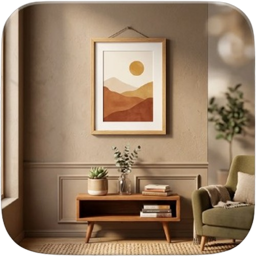
A piece floating on an empty white wall gives no scale at all. A piece above a sofa, or next to a door frame, or over a console table, gives the brain something to measure against. One photo per piece is enough, and it does more work than five studio shots.
Careful with generic mockups: if the same room appears behind forty different pieces at the same apparent size, the scale is fictional and attentive buyers notice. More on the two photos each piece needs.
3. Name your variants like a human would
"Option 2 / Black / M" tells the buyer nothing. "50 × 70 cm — framed in black oak (hangs at 61 × 81)" tells them everything. Variant naming looks like a housekeeping detail and it is actually a conversion lever, because a confused buyer doesn't ask, they leave.
How to structure the axes without hitting Shopify's limit.
4. Sell the frame on the same page
If the frame is a separate product, you've added a decision and a second trip to the catalogue. Most people won't take it. Put the frame in as a variant on the piece itself and the customer answers one question instead of two — and your order value goes up as a side effect.
5. Show it on their wall
This is the one that answers the question directly rather than approximating it. If the customer can hold up their phone and see the piece, at its real size, in its real frame, on the wall they're actually going to hang it on, the doubt doesn't get reduced — it disappears.
It's worth being precise about what "works" means here, because plenty of implementations don't: the piece has to be at true scale, the frame has to be the one they're buying, and it has to open from the product page without an app install. What separates a real implementation from an advertised one.
6. Shorten the path between wanting it and paying
Every step between the moment of desire and the payment loses people. If the customer has just seen the piece on their wall and liked it, the next thing in front of them should be a way to pay — not a back button, a catalogue, and a cart they have to rebuild.
How to know which one worked
Change one thing at a time, and give it enough orders to mean something. On a small store that is usually thirty days, not three.
And don't look only at conversion. Two numbers tell you more:
- Add-to-cart rate versus checkout completion. If people add and then abandon, your problem is at checkout — shipping cost, delivery time, returns policy. If they never add, your problem is on the product page, which is what this guide is about.
- Conversion by size. If the small sizes convert and the large ones don't, that is the scale problem showing up in your data, not a pricing problem. It's the single most diagnostic number in an art store and almost nobody segments it.
The four metrics worth watching, and the three you can ignore at the start.
Let them see it on their own wall
InRoom Wall Art shows every piece at real size, in the frame they're actually buying, on the customer's own wall — and puts the pay button inside the augmented reality, so there's no path back to the catalogue. Free plan of three artworks, no card.
See what it does →Keep reading: why shoppers abandon your product page.