 InRoom Wall Art
Home › Guides › How to sell art online
How to sell art online
It isn't one business, it's three, and nearly everything else follows from which one you're in. Here's the order to decide things - because some of them, like the print supplier, shape the whole catalogue.
Before you build anything: what exactly are you selling
"Selling art online" is three different businesses, and it's worth knowing which one you're in, because nearly everything else follows from it.
| Model | What it means | Typical margin |
|---|---|---|
| One-off original | One piece, one shipment, high price. No stock to manage, but no repeat either | High per piece, low volume |
| Limited edition | A numbered run. Real scarcity that justifies the price | Medium to high |
| Open-edition print | Printed without limit. This is what scales | Low per unit, high volume |
Most stores that work run two: open prints that bring traffic, and originals or editions that bring margin. Starting with originals alone is starting without a repeat engine.
Print it yourself, or print on demand
The decision that shapes the day-to-day most. Print on demand removes stock, space and risk, and removes margin and quality control too.
What people find out late: the supplier decides your sizes. If they work in inches, your catalogue is in inches. If their 30 × 40 frame has a 20 mm moulding, that's your moulding. Pick the supplier before you build the catalogue, not after.
Order one sample of every size you plan to sell, framed the way the customer will receive it. It costs a few euros and it's the only thing that tells you whether the colour on your screen is the colour on the paper.
Build the catalogue around how people buy
- Size is a variant, not a line in the description. In the dropdown the customer sees price and size together, at the moment of deciding.
- Frame is a variant too. Black, oak, unframed. It's the easiest order-value lift there is and plenty of stores don't even offer it.
- Publish the final mounted size, with frame and mat. That's what the customer compares against their wall. The maths is here.
Photos: two kinds, not one
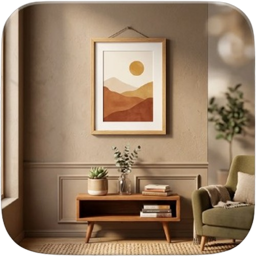
You need two images per piece and they do different jobs. The flat shot is for seeing what it is. The in-situ shot, hanging above furniture, is for seeing how much space it takes.
With only the flat shot there's no scale reference: a print on white looks the same size whether it's an A4 or a metre across. That's the number one cause of size returns.
Pricing without giving it away
The classic mistake is print cost plus a margin, and stop there. That's half of it:
- Printing and the frame
- Rigid packaging, which in art is not trivial
- Shipping, which still exists if you offer it free
- A percentage for breakage and returns. In framed art there always is one
- Gateway fees, plus the platform's if there is one
And a ladder that works: make the price jump between sizes smaller than the perceived jump in size. If the 50 × 70 costs thirty per cent more than the 30 × 40 but looks twice as big, customers size up on their own.
Marketplace or your own store
Marketplaces give you traffic from day one and charge for it in fees and in not owning the customer. Your own store gives you no traffic, but the customer is yours and so is the margin.
The practical answer is nearly always both, in this order: the marketplace as discovery while your store has no traffic, and your store as the place you send people who already know you. Worked through in the Shopify versus Etsy comparison.
First sales don't come from SEO
Worth saying plainly because it saves months: a new store doesn't sell through search. SEO takes three to six months to move anything. First sales come from duller places — your own people, a narrow niche ("botanical prints for kitchens" sells before "art for your home"), and interior designers, home stagers and gift shops, who buy in volume and repeat.
And the doubt that stops the sale
Once you have catalogue, photos and prices, the problem none of those fix is still there: the customer can't picture it on their wall. That doubt gets paid for in abandoned carts and returns. In-situ photos and a size guide reduce it. Letting them see it on their own wall before paying removes it.
Let them see it hanging before they buy
InRoom Wall Art shows every piece at real size, in its real frame, on your customer's wall — with nothing to install. Permanent free plan of three artworks, no card.
See it on the Shopify App Store →